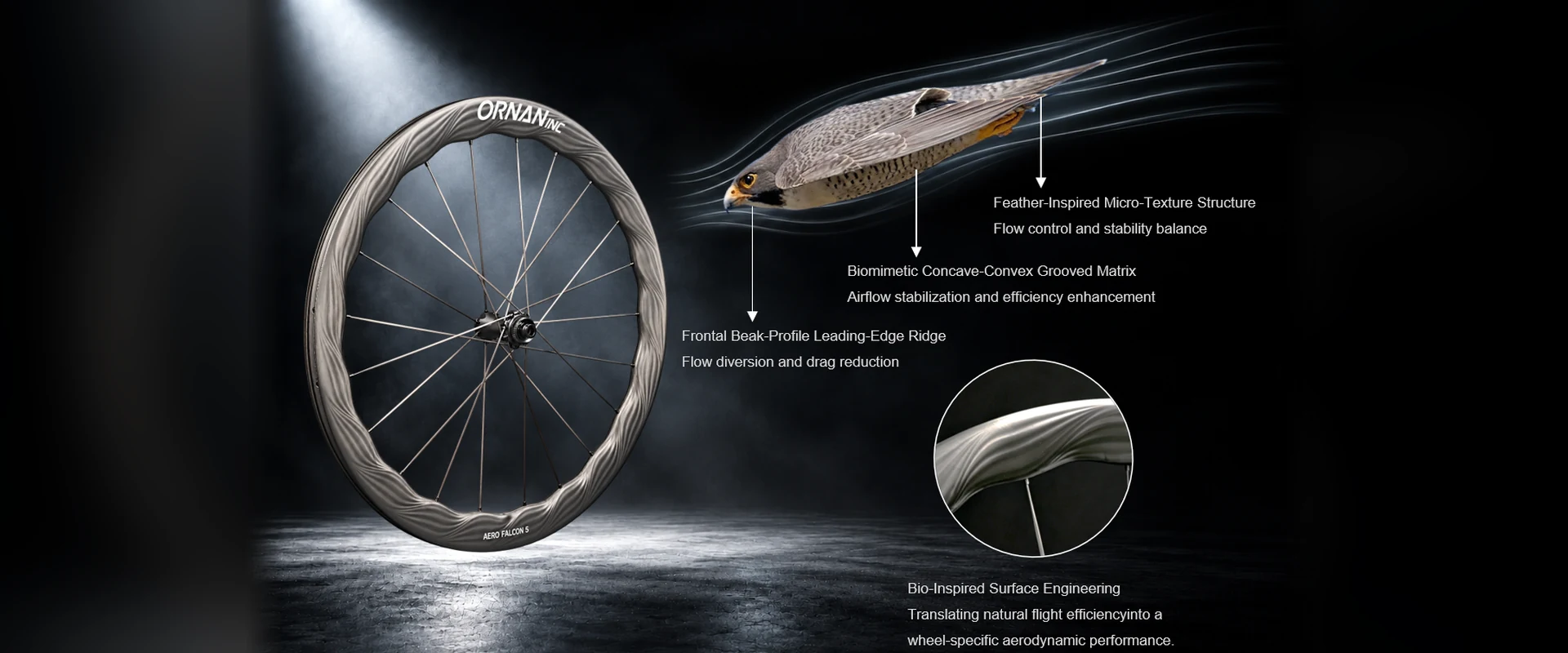
Inspired by the aerodynamic profile of a diving falcon, the Falcon 5 Series wheelsets feature the original AeroFalcon™ biomimetic concave-convex grooved and contoured surface design, engineered to translate the streamlined profiles of falcon’s head, body, and tail into an aerodynamic rim profile structure. We applied this biomimetic design on both Road Aero Falcon 5 Wheels and Gravel Falcon 5 Wheels and wheelsets are UCI-certified and race legal.
The beak-profile leading-edge ridge at the front of the AeroFalcon™ structure is engineered for splitting the oncoming airflow. The mid-section biomimetic concave-convex grooved surface gradually tapers into the rear tail-wing profile, guiding the airflow trajectory for a smoother transition across the rim. This design actively balances the inner-outer pressure differential and minimizes surface friction, thereby delaying boundary layer separation, improving crosswind stability and overall aerodynamic efficiency.
Each detail has been refined through repeated engineering optimization and integrated with advanced carbon fiber layup technology to deliver a precise balance of structural integrity and pure speed.
This technology is currently protected by two Design Patents (ZL 2024 3 0808113.9, ZL 2025 3 0044695.2) and one Utility Model Patent (ZL 2025 2 1010098.9).
Aerodynamic Principles of AeroFalcon™ Design
Shaped by millions of years of evolution in nature, the falcon has perfected its body structure to maximize aerodynamic efficiency. Inspired by this apex predator, we engineered the AeroFalcon™ biomimetic structure and applied it to the rim surface, translating natural flight efficiency into a wheel-specific aerodynamic structure.
Frontal Beak-Profile Leading-Edge Ridge — Flow diversion and drag reduction
The front section of AeroFalcon™ features a sharp, streamlined profile inspired by a falcon’s beak. Its beak-profile leading-edge ridge organizes oncoming airflow into multiple controlled airflow streams, reducing direct airflow impact on the rim surface and helping control turbulent flow formation. As the wheel rotates, controlled micro-vortices help accelerate airflow attachment along the rim surface, delaying flow separation and reducing pressure drag.
Mid-Section Biomimetic Concave-Convex Grooved Matrix — Airflow stabilization and efficiency enhancement
The mid-section of AeroFalcon™ is inspired by the smooth concave-convex grooved structure formed as a diving falcon tucks its wings. The continuous curved transitions between the concave-convex grooves create a Venturi-like effect, helping stabilize the airflow trajectory, balance the inner-outer pressure differential across the rim, and reduce lateral turbulence. Furthermore, the continuous concave-convex grooves create a micro-undulating texture across the rim surface. Working together with the rim’s high-peak and low-valley profile design, these channels help guide water toward the outer edge under rotational centrifugal force, supporting more consistent aerodynamic performance on demanding wet-weather stages.
Tail-Section Feather-Inspired Micro-Texture Structure— Flow control and stability balance
The tail section of AeroFalcon™ simulates the feather distribution of a falcon’s tail. As the rear profile tapers inward, its surface micro-texture helps manage the wake region by breaking large-scale vortices into smaller, more controlled micro-vortices. This reduces wake turbulence intensity and helps lower induced drag. The micro-texture also helps suppress the low-pressure suction effect, allowing it to transition into a more stable and organized wake for smoother airflow release from the rim surface.
How AeroFalcon™ Improves Riding Speed.
Drag Optimization
The flow-guiding ridges and concave-convex grooved surface work together to manage airflow across the rim, helping it stay smoother and more attached as the wheel cuts through the air. This reduces turbulent flow separation and wake disturbance, delivering a more efficient aerodynamic response in headwind conditions.
Efficient Power Transfer
As the wheel rotates, airflow is systematically channeled by the flow-guiding ridges and concave-convex grooved matrix, minimizing aerodynamic interference and buffeting against the spokes and frame, reducing unnecessary energy loss and supporting more efficient power delivery to maintain a stable cruising speed.
Crosswind Stability Across Yaw Angles
In crosswinds and shifting wind conditions, the AeroFalcon™ structure helps balance airflow across the rim surface. Its front, mid, and rear aerodynamic sections work together to reduce sudden pressure changes, giving the rider greater stability and control during high-speed cruising, descending, and cornering.
Crosswind Stability and Cornering Composure
Crosswind Flow-Splitting
In crosswind conditions, the flow-guiding ridge helps manage lateral airflow across the rim surface. The concave-convex grooved matrix promotes a more even distribution of side forces, reducing sudden localized pressure changes that can affect handling stability.
Vortex Balance Management
During cornering, the rear-section micro-texture helps organize airflow on both sides of the wheels and promotes a more balanced wake structure. This reduces lateral oscillation, supports rim stability through the turn, and minimizes the amount of steering correction required from the rider.
Rotational Inertia Optimization
The optimized aerodynamics of the AeroFalcon™ design reduce unstable aerodynamic buffeting against the rim profile. This minimizes dynamic attitude disturbance during high-speed rotation, greatly enhancing cornering responsiveness and steering agility.
Oncoming Airflow Stability
Enhanced Flow Attachment
The flow-guiding ridge helps organize oncoming airflow into smoother, more controlled streams. The concave-convex grooved structure creates a Venturi-like local acceleration effect, helping airflow remain attached to the rim surface and reducing pressure fluctuations caused by flow separation.
Dynamic Pressure Balance
As the wheel rotates, the flow-guiding concave-convex grooved matrix helps regulate local airflow pressure around the rim. By reducing the pressure imbalance between the windward and leeward sides, it helps minimize periodic aerodynamic vibration and improves riding comfort.
Aerodynamic Backflow Analysis
Adverse Pressure Gradient Mitigation via Flow-Guiding Ridge
During high-speed wheel rotation, the trailing-edge area can be affected by adverse pressure gradients, which may cause localized airflow recirculation. The flow-guiding ridge helps manage the pressure transition between the high-pressure leading-edge zone and the low-pressure trailing section, guiding airflow more consistently along the rim surface and reducing backflow tendency.
Micro-Texture Turbulence Dissipation
The rear-section micro-texture increases surface-level viscous dissipation, helping weaken recirculating airflow and break down unstable turbulent flow. This supports a cleaner wake structure and smoother airflow release from the rim surface.
Power Transfer Architecture
Spoke Lacing and Hub Support
Engineered with a 2:1 lacing pattern for both front and rear hubs, which optimizes the spoke tension balance between the drive-side (DS) and non-drive-side (NDS) spokes. The hub is equipped with 15267 & 6802 ceramic bearings, substantially bolstering axial stiffness and bearing service life.
Low Friction, Durable Performance
Ceramic bearings reduce internal friction for a smoother, more efficient rolling feel. This helps convert rider input into forward motion with less mechanical loss, while maintaining consistent performance across demanding road and environmental conditions.
Stiffness and Lightweight Optimization
Each spoke weighs only 2.1 g. The ultralight carbon spokes with titanium-alloy material works with the optimized rim structure to deliver high lateral stiffness, precise handling, and efficient power transfer.
Paint Free Technology
The paint free finish is made possible by advancements in high-precision tooling, accurate carbon layup control, and advanced molding processes. During high-temperature and high-pressure curing, the epoxy resin within the prepreg flows and fully cross-links, allowing the carbon composite to conform closely to the mold surface and form a dense, continuous, and stable resin-rich outer layer.
Once released from the mold, this molded surface serves directly as the final exterior finish of the rim, requiring only minimal localized post-processing. Conventional paint and heavy clear coats are therefore unnecessary, allowing the natural texture and visual character of the carbon fiber to remain clearly visible.
Because a paint free finish directly reveals the as-molded carbon surface, its appearance differs from that of conventionally painted rims and is not intended to achieve a perfectly uniform, mirror-like cosmetic finish. Minor mold parting-line marks, subtle visibility of the carbon fiber texture, and slight variations in resin flow or surface gloss may occasionally be present.
These are natural characteristics of the paintless carbon molding process rather than manufacturing defects. When within our production and inspection standards, such cosmetic variations have no effect on the structural integrity, strength, performance, or normal use of the rim.